
Key Highlights:
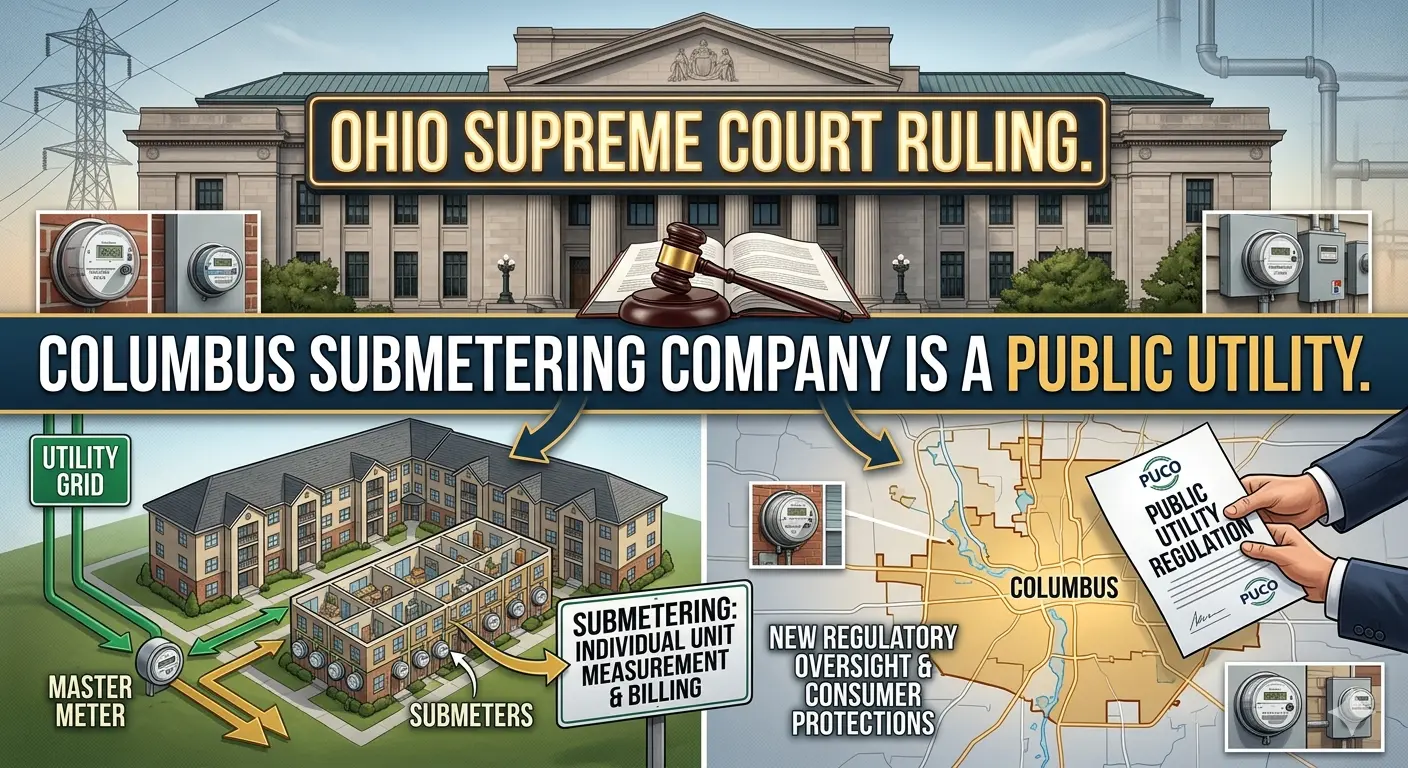
- The Ohio Supreme Court ruled Wednesday that Nationwide Energy Partners, a Columbus-area submetering company, is a public utility subject to regulation by the Public Utilities Commission of Ohio.
- The unanimous decision reverses a prior PUCO order and remands the case for proceedings that could result in fines against Nationwide Energy Partners for operating without proper authorization in AEP Ohio’s service territory.
- Columbus City Councilmember Christopher Wyche called the ruling a win for residents who have faced inflated electricity bills with no regulatory recourse.
The Ohio Supreme Court issued a ruling Wednesday that reshapes how electricity is sold to tens of thousands of apartment renters across Columbus and the rest of Ohio. The court held that a submetering company that arranged with landlords to sell electricity to apartment tenants is a public utility subject to regulation by the Public Utilities Commission of Ohio, reversing a prior PUCO order that had concluded Nationwide Energy Partners was not a public utility. The decision, captioned In re Complaint of Ohio Power Co. v. Nationwide Energy Partners, Slip Opinion No. 2026-Ohio-1406, was handed down April 22 by the high court sitting in Columbus near the intersection of South Front Street and West Broad Street.
Columbus Apartment Tenants at Center of Dispute That Reached State’s Highest Court
The case originated in 2020 when Nationwide Energy Partners moved into the Columbus rental market. NEP contracted with landlords of five large apartment complexes in the Columbus area for the right to supply electrical service to their tenants, who had previously been purchasing power directly from AEP Ohio. NEP asked AEP to alter the meters to allow the submetering arrangement. AEP Ohio denied the requests and then filed a complaint with the PUCO, claiming the submetering company was unlawfully operating as a public utility in violation of state law.
The PUCO sided with NEP at the agency level, concluding that because landlords — not tenants — are the direct customers of record, NEP was operating as a landlord’s agent and therefore exempt from utility regulation. The PUCO reasoned that there is a landlord-tenant exception under which a landlord is not deemed to be in the business of supplying electricity to tenants, and since NEP is the landlord’s agent, NEP also enjoys the exception. The Supreme Court rejected that reasoning.
Writing for the majority, Justice R. Patrick DeWine found the distinction unpersuasive. DeWine wrote that despite NEP’s arguments, the company behaves almost indistinguishably from a utility: it sources electricity, installs equipment, and distributes power over a grid. “It directly bills tenants for their use of electricity and may disconnect service if a tenant fails to pay. It earns a profit based on the difference between the price it pays for electricity and the price it resells electricity,” DeWine wrote. “In short, NEP is in the business of supplying electricity to consumers.”
The court also rejected NEP’s argument that tenants are not consumers under Ohio law, explaining that both landlords and tenants can qualify as consumers — landlords when they purchase utility services, and tenants when they use those services such as electricity to light a room. The court further found that the landlord exemption in Ohio law applies only when a landlord resells utilities as an incidental part of renting property — not when a separate third-party company is structured specifically around the business of reselling electricity for profit.
Ruling Sends Case Back to PUCO; Fines Possible Against Nationwide Energy Partners
The court did not impose penalties directly. It remanded the case to the PUCO to consider whether Nationwide Energy Partners has been improperly supplying electricity in AEP Ohio’s service territory and whether the company has been operating as an unregistered electric supplier — both of which could result in fines.
The decision was effectively unanimous, though not without a caveat. Chief Justice Sharon L. Kennedy and Justices Patrick F. Fischer, Daniel R. Hawkins, and Megan E. Shanahan joined Justice DeWine’s opinion. Justice Jennifer Brunner, the court’s lone Democrat, concurred in the judgment only, agreeing with the outcome but not the majority’s legal reasoning.
The director of the Ohio Consumers’ Counsel — the state agency that advocates for residential ratepayers before the PUCO — framed the ruling in direct terms. “No company gets to sell essential electric service in Ohio without playing by the rules,” said Maureen Willis, the agency’s director.
Columbus City Councilmember Christopher Wyche, who chairs the City Council’s Public Utilities and Sustainability Committee, issued a statement hours after the decision. “For years, residents have complained about inflated utility bills with no access to regulatory safeguards,” Wyche said, calling the ruling a win for consumers. Under a Columbus city ordinance already on the books, submetering companies had been given until December 2026 to comply with billing transparency and consumer protection measures. Wednesday’s state Supreme Court ruling now adds a layer of PUCO oversight on top of those local requirements.
Submetering Industry Has Operated in Regulatory Gap for Two Decades
Since the early 20th century, states have maintained a basic arrangement with utility companies: utilities receive economic monopolies to avoid a redundant infrastructure of poles and wires, and states in return impose robust regulatory systems to ensure customers are treated fairly. The rise of submetering companies over the past two decades in Ohio disrupted that structure.
Submetering companies maintain they buy electricity at discounted commercial rates before reselling to residential customers at residential prices, and NEP officials have insisted they charge customers no higher than standard utility rates. Critics, including tenant advocates active in Columbus neighborhoods like Franklinton and the South Side — where large apartment complexes served by NEP are concentrated have disputed that claim, arguing the lack of PUCO oversight left renters with no mechanism to challenge billing errors or excessive charges.
The case drew intense lobbying attention at the Ohio Statehouse. Nationwide Energy Partners has been paying eight registered lobbyists to represent its interests before lawmakers, disclosure records show, and the company had been pushing legislators to preemptively change state law to explicitly designate submetering companies as non-utilities ahead of the court’s ruling. That effort did not succeed before Wednesday’s decision.
Rep. Sean Brennan, a Parma Democrat who has sought a legislative crackdown on submetering for years, told reporters he was elated when the ruling came down. “Almost in tears,” Brennan said.
The PUCO has not yet announced a timeline for the proceedings on remand. Nationwide Energy Partners had not issued a public statement as of Wednesday evening. Columbus renters in apartment complexes currently served by NEP should expect PUCO proceedings to determine whether any billing adjustments or refunds are warranted — a process that, under standard PUCO procedure, can take months to complete through the commission’s offices on South High Street Downtown.
Sources
- Ohio Supreme Court, Slip Opinion No. 2026-Ohio-1406, In re Complaint of Ohio Power Co. v. Nationwide Energy Partners, April 22, 2026
- Court News Ohio / Office of Public Information, Opinion Summary, April 22, 2026
- WOSU 89.7 NPR News, Ruling Coverage, April 22, 2026
- WKYC / Associated Press, Ruling Coverage, April 22, 2026
- WVXU Cincinnati Public Radio, Ruling Coverage, April 22, 2026
Author
Jonathan Pierce | ColumbusFrontline.com Reporter covering Franklin County courts, Columbus housing policy, and Ohio utility regulation since 2018.
Last Updated: April 23, 2026 at 11:00 ET
This report is based on information available at time of publication. Details may change as PUCO remand proceedings develop. ColumbusFrontline.com will update this article as new information is confirmed.