
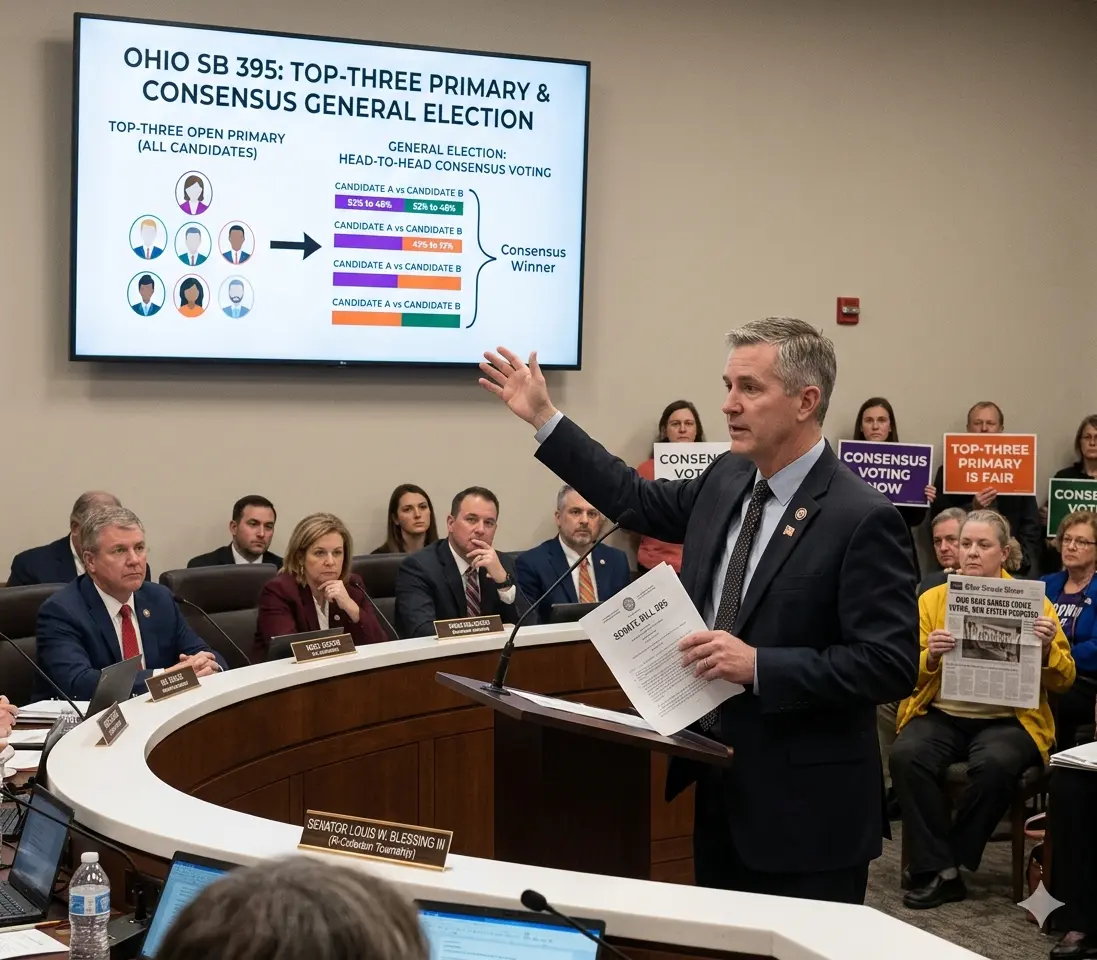
An Ohio state senator has introduced legislation at the Statehouse in Columbus that would fundamentally restructure how Ohioans elect their representatives — replacing the current partisan primary system with a top-three open primary and a head-to-head “consensus voting” general election. The bill arrives roughly one month after Governor Mike DeWine signed into law a measure banning ranked choice voting in the state.
State Senator Louis W. Blessing III (R-Colerain Township) introduced Senate Bill 395, which implements a top-three primary and consensus general election system in Ohio. The bill has been referred to the Senate General Government Committee for further consideration. No hearing date has been scheduled as of publication.
How Consensus Voting Would Work
Under SB 395, Ohio’s current partisan primaries would be replaced with a single open primary in which all candidates, regardless of party, compete together. The top three vote-getters from that primary would advance to the November general election, regardless of party affiliation.
The general election mechanism — consensus voting — differs from both the current plurality system and ranked choice voting. Voters would see three head-to-head match-ups on their ballot: Candidate A vs. Candidate B; Candidate A vs. Candidate C; and Candidate B vs. Candidate C. Voters select one candidate in each pairing, as in a standard vote today. The candidate who wins both of their match-ups wins the election outright. If each candidate wins one match-up — a three-way tie — the winner is determined by which candidate lost their one loss by the smallest margin.
In the event of such a three-way tie, the winner is the candidate whose head-to-head defeat is the narrowest, on the grounds that candidate came closest to winning a second match-up.
Blessing compared the mechanics to the NCAA March Madness Tournament bracket, noting that the tournament — which involves 68 teams across multiple rounds — is significantly more complex than the three-candidate head-to-head format proposed in SB 395.
The Case Blessing Makes
Blessing framed the bill as a direct response to the gap left by Ohio’s newly enacted ban on ranked choice voting. In a statement accompanying the bill’s introduction, Blessing acknowledged voting in favor of SB 63 — the ranked choice ban — while stating that the underlying problems ranked choice sought to address “are very real.”
Blessing has previously argued that Ohio’s current primary system rewards partisanship because candidates can win a primary by appealing to a narrow base and, in heavily partisan districts, effectively win the general election by doing so. He pointed to Ohio’s registered voter composition as central to his argument: registered Republicans and Democrats combined — and then doubled — remain roughly one million voters short of the total number of Ohioans registered as unaffiliated.
Blessing argued that under consensus voting, major-party candidates could no longer afford to ignore independent voters, creating what he described as a gravitational pull toward broader voter appeal. He also contended the system would reduce the influence of large political donors, because the expanded and ideologically diverse target audience would make narrowly targeted ad campaigns less effective.
Legislative Context
SB 395 enters a legislature that has actively debated alternative voting systems in recent months. Ohio Senate Bill 63, which bans ranked choice voting statewide, passed with strong Republican support and was signed into law earlier this year.
SB 395 would also affect ballot access for minor parties. Under current Ohio law, a party maintains qualified status by receiving at least 3 percent of the vote for governor or president. The proposed top-three system would make it more difficult for minor parties to meet that threshold, according to ballot access analysts.
No companion bill has been introduced in the Ohio House of Representatives. The Senate General Government Committee has not yet scheduled a hearing on SB 395. Authorities have not confirmed additional details on the bill’s timeline or prospects for a floor vote.
Franklin County residents with questions about Ohio’s current May 5 primary voting procedures can visit vote.franklincountyohio.gov or call the Franklin County Board of Elections at 614-525-5393.
Sources
- Ohio Senate — Official press release, Sen. Louis W. Blessing III, “Blessing Introduces Bill Establishing a Consensus Voting System in Ohio,” April 7, 2026 (ohiosenate.gov)
- Ohio Legislature — Senate Bill 395 status page, 136th General Assembly (legislature.ohio.gov/legislation/136/sb395/status)
Last Updated: May 2, 2026 at 1:15 ET
Disclaimer: This article is based on information released by Columbus authorities and reputable sources at the time of publication. Details may change as investigations continue.