
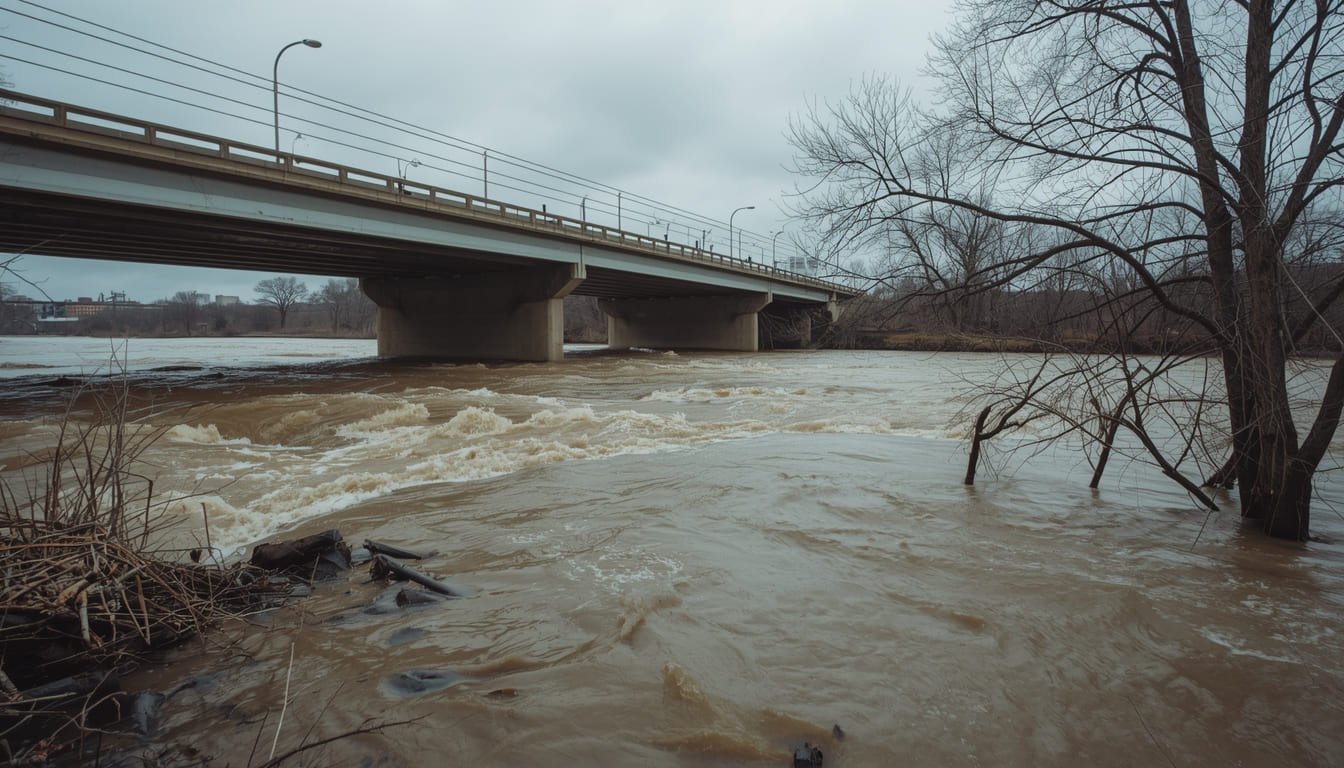
COLUMBUS — Charles Hughes still remembers the call from his son. It was May 2020, and floodwater from the Olentangy River was rising fast on the dead-end street near Broad Meadows Boulevard in Clintonville. Neighbors were throwing what they could into their cars. His son’s family waded through the water just to reach the driveway.
“They waded out into the water, you know, and got in the car and we went down to our house,” Hughes said.
Four years later, Hughes is watching the forecast again.
Why Clintonville Is on Alert Right Now
Columbus received 3.92 inches of rain over eight days ending earlier this week. That is a lot of water, and the ground has nowhere to put it. The Olentangy River near Worthington peaked at 8.47 feet — still more than two feet below its 11-foot flood stage. The Scioto River at Frank Road peaked at 22.39 feet, just over a foot below its 24-foot flood stage.
The rivers have not flooded. But saturated ground means even a moderate rain can push them toward their banks fast. More storms are possible through Thursday, Friday, and Saturday, according to WBNS 10TV meteorologists, who placed the forecast period under a Weather Impact Alert Day designation.
River and stream flood warnings remain in effect in parts of Franklin County as water continues draining downstream.
200 Flooded Basements Already Reported
The Columbus Department of Public Utilities said its sewer maintenance operations center received approximately 200 calls from Columbus residents reporting flooded basements during the recent stretch of heavy rain. A spokesperson confirmed the high call volume this week.
Governor DeWine: Most of Ohio Is Under a Flood Watch
Ohio Gov. Mike DeWine addressed the flooding threat at a press conference alongside Lt. Gov. Jim Tressel this week. DeWine said the situation is being monitored closely across the entire state.
“We have observed from the air and on the ground that our ground is really saturated here in Ohio,” DeWine said. “Our biggest concern right now, particularly for the southern half of Ohio, is flooding and flash flooding.”
DeWine noted that nearly all of Ohio is under a Flood Watch, while the southernmost part of the state is under a Flood Warning.
What the 2020 Flood Looked Like
In May 2020, the Olentangy River overflowed onto the Olentangy Trail bike path and flooded Broad Meadows Boulevard where the road meets the river. A car was stranded near Columbus Park of Roses, which was completely overrun by river water. Drivers approaching the area could have driven directly into the river without realizing it. The floodwaters came close to nearby apartment buildings but did not cause structural damage.
That same spring, flooding hit Franklinton, Powell, and Westerville hard enough that residents had to be rescued by boat, according to ABC6.
Why the Dam Upstream Helps — But Is Not a Guarantee
The U.S. Army Corps of Engineers Delaware Dam sits 32 miles upstream of Columbus in Delaware County. Built in 1951, it holds back up to 132,000 acre-feet of water — the equivalent of 6.5 inches of runoff across its entire drainage area. The dam has significantly reduced flooding on the Olentangy through Franklin County for decades.
But during sustained stretches of heavy rainfall like this one, even the dam’s protection has limits. Low-lying streets in Clintonville, including the cul-de-sacs near Broad Meadows Boulevard, can still flood when the ground is this saturated.
What Clintonville Residents Should Do
Residents can track current flood watches and warnings through the National Weather Service office in Wilmington, Ohio at weather.gov/iln. Anyone with a flooded basement or drainage emergency can call the Columbus Department of Public Utilities emergency line at 614-645-7788.
The Franklin County Emergency Management Agency warns residents never to drive or walk through flooded roads. Just 12 inches of moving water is enough to sweep a vehicle away.
Hughes said he hopes it does not come to that this time. But he is keeping his phone close.
This article is based on information from the National Weather Service Wilmington office, the U.S. Army Corps of Engineers, the Columbus Department of Public Utilities, Ohio Gov. Mike DeWine’s press conference. River levels are subject to rapid change. Residents should consult official NWS advisories for the most current conditions.