
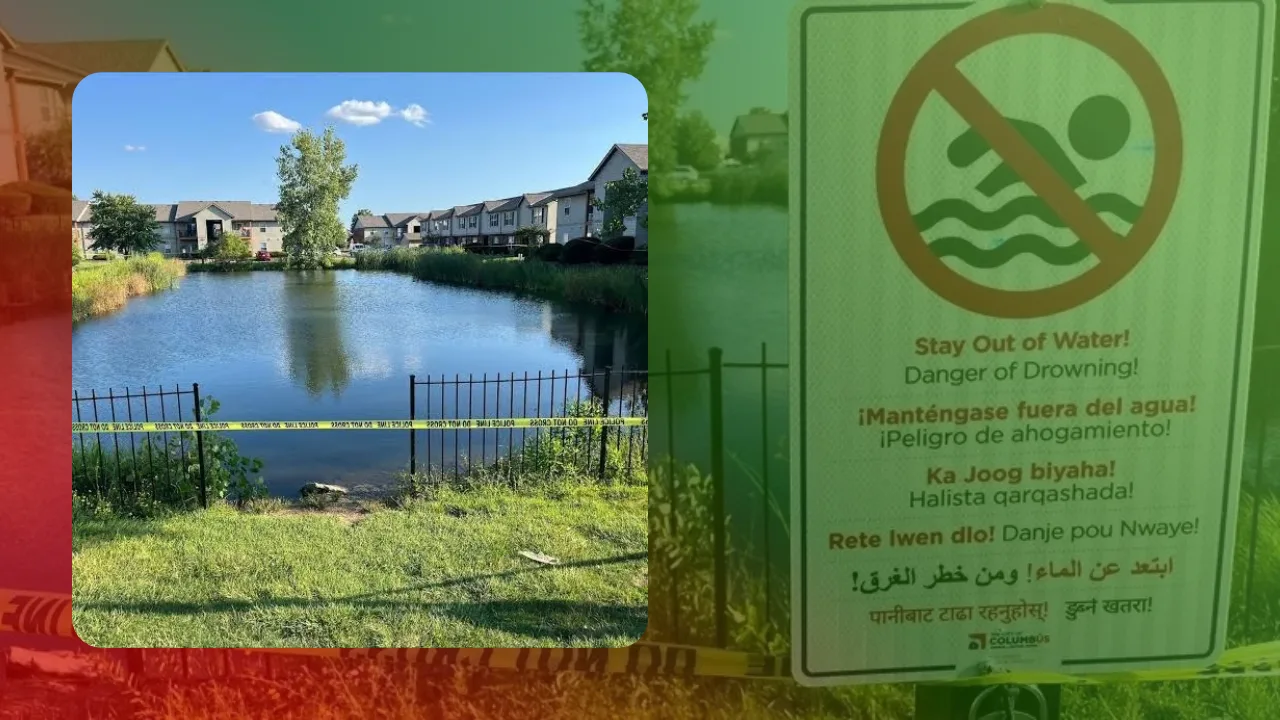
Columbus City Council approved new safety requirements for apartment retention ponds on November 2, requiring property owners to maintain an unmowed vegetation buffer extending at least 15 feet from the water’s edge and provide residents with clearer written drowning warnings. The changes follow two documented toddler drowning deaths at Columbus apartment complexes in 2026 and concerns about whether existing safety requirements adequately protect children around stormwater ponds.
The legislation, Ordinance 3052-2026, also requires safety notices to be delivered as separate written documents and displayed in common areas where residents can see them. It amends Columbus City Code Sections 709.03 and 4525.17, expanding requirements established by an earlier city law passed in December 2024.
The new measure does not create a universal requirement to fence every apartment retention pond. Instead, it adds a natural vegetation buffer while allowing the city to require more substantial corrective measures at properties formally determined to be public nuisances.
What exactly did Columbus City Council approve?
Council approved Ordinance 3052-2026, sponsored by Councilmember Rob Dorans.
The legislation addresses two primary problems: the physical safety of apartment retention ponds and whether residents receive adequate warnings about the drowning risks.
The main changes include:
- A minimum 15-foot vegetation buffer measured from the water’s edge.
- A prohibition on mowing or cutting existing vegetation within that buffer.
- Written pond-safety notices delivered to residents as a separate document.
- Safety notices posted in a shared or common area of the residential property.
- Additional information in notices when the city has formally declared a pond a public nuisance, including the city’s reasons for that designation.
The vegetation requirement is intended to provide a natural barrier between residential areas and open water.
The additional notice requirements are intended to make the dangers more visible to tenants rather than relying on information buried inside a lease or general apartment paperwork.
Council approved the measure as an emergency ordinance. Its effective-date language provides for it to take effect upon passage and mayoral approval, or 10 days after passage if the mayor neither approves nor vetoes it.
The final mayoral action should be checked in the city’s legislative record before treating the new provisions as fully effective.
Does the new law require apartment complexes to build fences around ponds?
No. One of the most important details in Ordinance 3052-2026 is what it does not require.
The legislation does not order every apartment owner to install a permanent metal, chain-link or other physical fence around every retention pond.
Instead, it requires the property owner to maintain the existing vegetation within a 15-foot buffer around the water.
Under the new approach, grass and other existing vegetation within that area must not be mowed or cut as part of ordinary maintenance.
The intention is to create a natural separation between the water and nearby residential areas.
Councilmember Rob Dorans has described the vegetation buffer as a measure that could be replaced later by stronger physical barriers.
During discussion of future safety requirements, Dorans said he hoped the no-mow requirement could eventually be repealed once more stringent barriers were in place.
That means the November 2 legislation should be understood as an additional safety measure, not the final version of Columbus’ retention-pond policy.
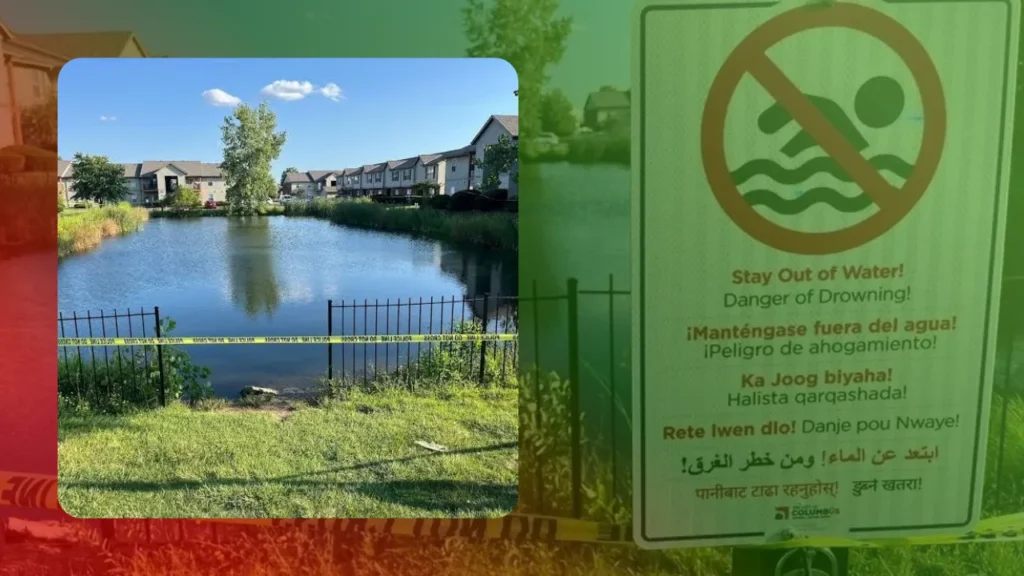
Which apartment ponds are covered by the new rules?
The requirements do not apply automatically to every body of water in Columbus.
The city uses a specific legal definition of a multi-unit residential pond under Columbus City Code Section 4501.205.
Generally, a qualifying pond must be:
- An artificial pond on privately owned property used for multi-unit residential purposes.
- Designed to retain a permanent pool of water.
- More than 20 feet wide at its widest point.
- Accessible to residents of the property.
The definition includes certain stormwater retention facilities and wet extended-detention basins.
The code also defines a permanent pool of water as water more than 18 inches deep that remains standing or impounded for more than 24 hours.
This distinction matters because the legislation is directed at residential properties with qualifying ponds, not every decorative water feature, natural lake or temporary accumulation of rainwater.
Apartment owners should verify whether a particular facility falls within the city’s definition before deciding that the requirements do or do not apply.
What safety equipment must apartment owners already provide?
The November 2026 amendment builds on requirements approved under Ordinance 3439-2024.
That earlier legislation established safety requirements for multi-unit residential ponds, with the main physical installation obligations applying beginning July 1, 2025.
Under Columbus City Code Section 4525.17, qualifying property owners must provide several safety features.
1. Drowning warning signs
Owners must post signs around the pond warning residents about the dangers of entering the water.
The city’s implementing rules specify a minimum of four signs, positioned around the north, south, east and west sides of the pond.
The signs must meet the city’s size, wording, visibility and durability requirements.
2. Life-saving equipment
Properties must provide approved life-saving equipment near the pond.
The city’s rules recognize U.S. Coast Guard-approved Type IV personal flotation devices, including ring buoys, as well as approved throw bags or equivalent equipment.
Rescue stations must be distributed around the pond, with no more than 300 feet between stations.
Where a ring buoy is provided, the rules specify an attached line measuring approximately one-quarter inch in diameter and between 30 and 60 feet long.
These devices are intended to give someone outside the water a way to assist a person who is struggling.
3. Written notices to residents
Property owners must warn residents about the risk of drowning and explain which safety features are available.
The original law required notices when residents move into a property and annually afterward.
The new legislation strengthens this requirement by requiring the notice to be delivered as a separate written document and posted in a common area.
4. Safety shelves for newly constructed ponds
For qualifying ponds constructed after the original legislation, the law requires a submerged bench or safety shelf near the shoreline, designed in accordance with the city’s stormwater requirements.
This is a particularly important distinction: the safety-shelf requirement does not automatically mean every existing older apartment pond must be reconstructed.
The new vegetation buffer and strengthened communications requirements are separate additions to the existing rules.
What happened to the two children who drowned in Columbus apartment ponds?
Two 2026 incidents have received particular attention in the local debate.
July 29: Two-year-old Georgina Villar dies at Bayside Commons
Two-year-old Georgina Villar died after being found in a retention pond at Bayside Commons Apartment Homes in northwest Columbus on July 29.
Police responded to the apartment community near Sebago Lane after receiving a report involving a child in the water.
An officer found the toddler face-down in the pond, pulled her from the water and began emergency lifesaving efforts.
Columbus fire personnel transported her to Nationwide Children’s Hospital, where she was pronounced dead.
The incident raised questions about whether the property’s existing safety measures were sufficient to prevent young children from reaching the water.
Subsequent city enforcement reporting identified a problem at Bayside Commons involving the absence of required Coast Guard-approved life-saving equipment.
The citation concerning missing equipment is a reported code-enforcement issue. It should not automatically be treated as a finding that the violation caused the child’s death.
September 27: Two-year-old Benny Mbombo dies at Polaris Place
Another toddler drowning occurred on September 27 at Polaris Place Apartments in the 900 block of Antar Place on Columbus’ Far North Side.
Two-year-old Benny Mbombo was reported missing while his family was preparing to leave for church.
Police and neighbors searched the area. Officers eventually found the child in a retention pond.
A police dive team recovered his body at approximately 3:46 p.m.
The Delaware County Coroner’s Office initially classified the death as an accidental drowning.
There was no fence around the retention pond.
However, city officials told reporters that Polaris Place had met the existing 2024 pond-safety requirements, including the presence of warning signs and life-saving equipment.
That distinction became important in the legislative debate.
It showed that a property could meet the existing sign and rescue-equipment rules while still having an unfenced pond accessible from residential areas.
The new 15-foot buffer attempts to address part of that physical-access problem without immediately imposing a universal fencing mandate.
Why are the existing warning signs and life rings not enough?
The two incidents raised a broader question about the difference between having safety equipment and actually preventing a child from entering dangerous water.
Warning signs may inform adults about a hazard, but a young child may not understand those warnings.
A life ring may help someone attempt a rescue, but it does not prevent a child from reaching the pond.
The Columbus requirements adopted in 2024 concentrated on warning signs, rescue equipment, resident notices and safety shelves for newly constructed ponds.
The 2026 amendment adds a physical separation measure through the unmowed vegetation zone.
The Polaris Place incident also demonstrated that compliance with existing pond regulations does not necessarily mean a pond is physically inaccessible to young children.
This is one of the central issues city officials must address as they consider further changes to the code.
How many apartment ponds has Columbus inspected?
The city has been inspecting residential retention ponds since the original safety ordinance took effect.
At an October 22, 2026, public hearing, Columbus officials reported that approximately 110 residential ponds were subject to the regulations.
Officials also reported that inspections had identified violations at 28 properties.
Of those properties:
- 23 had come into compliance.
- Five remained under follow-up by city officials.
These figures provide a picture of the work required to bring existing residential developments into compliance.
They also show that passing a safety ordinance does not automatically ensure that every property owner installs the required equipment or provides all required notices.
An additional issue is whether inspections will continue regularly and whether future violations will result in stronger enforcement.
Can Columbus declare an apartment retention pond a public nuisance?
Yes.
Columbus City Code Section 4501.275 establishes circumstances under which a qualifying residential pond can be declared a public nuisance.
The definition includes a pond where a person has drowned or experienced a near-drowning incident.
It can also include a pond that presents a significant risk of serious injury or death because required safety features are missing.
However, the classification is not simply automatic whenever a drowning occurs.
The appropriate city department must review the circumstances and make a formal determination.
Under the existing code, Columbus Public Health, the Department of Neighborhoods and the Department of Public Safety must notify the Building and Zoning Services director in writing within 14 calendar days after a qualifying serious injury or drowning.
The director must review the incident, consider any previous serious injuries or deaths at the property and evaluate whether the pond meets the nuisance definition.
This review is important because it creates a process for examining the property’s overall safety record rather than treating each drowning as an isolated emergency.
What happened after the July drowning?
A Columbus Dispatch investigation published October 2 reported that city officials had not formally declared any of the inspected residential ponds public nuisances at that point.
That reporting raised questions about whether the existing nuisance process was being used aggressively enough after serious incidents.
The new legislation strengthens resident notification when a pond has received such a designation, but it does not eliminate the need for the city to formally investigate and determine whether the legal conditions for a nuisance finding exist.
The public nuisance process therefore remains an important enforcement mechanism.
What penalties can apartment owners face for ignoring pond safety orders?
Columbus City Code Section 4509.90 provides the city’s enforcement process for public-nuisance conditions.
When officials identify a qualifying violation, the director can issue a written notice describing the problem and ordering the owner to correct it within a specified period.
The notice must explain the conditions requiring correction and provide the owner with information about the right to appeal.
If the owner fails to comply with an abatement order, the city can pursue additional enforcement.
Available measures include:
- Civil or criminal enforcement proceedings.
- City-performed corrective work, with eligible costs assessed against the property.
- A civil penalty of up to $1,000 for each calendar day after the deadline established in an abatement order.
The $1,000 daily penalty is not an automatic fine for every apartment pond that lacks a fence.
It is associated with the city’s enforcement of an applicable abatement order after the required process.
Can an apartment owner appeal a violation?
Yes.
An owner can appeal a notice of violation to the Property Maintenance Appeals Board within 15 days.
The board generally must conduct a hearing within 45 days when an appeal is properly filed.
The city director must establish the violation through a preponderance of substantial, reliable and probative evidence.
A board decision may subsequently be appealed to the Environmental Division of the Franklin County Municipal Court under Ohio Revised Code Chapter 2506.
These procedures give property owners an opportunity to dispute findings while preserving the city’s ability to require corrective action when violations are established.
Why hasn’t Columbus required permanent fences around every retention pond?
Permanent fencing has been part of the public debate, but it raises questions about costs, maintenance, access for emergency responders and the natural environment around stormwater facilities.
Representatives of apartment property owners have raised concerns about making fencing mandatory at every pond.
Some argue that barriers could create maintenance and environmental challenges or interfere with emergency rescue access.
Supporters of stronger physical barriers argue that children should not be able to walk directly into potentially dangerous water from residential grounds.
The city has chosen a staged approach so far.
The original 2024 law established signs and rescue equipment. The 2026 amendment adds a vegetation buffer and stronger warnings. Councilmembers have also discussed additional physical-barrier requirements.
Dorans has indicated that the city could consider stricter barriers in subsequent legislation before eventually eliminating the temporary no-mow requirement.
The debate is therefore not finished.
What apartment residents should look for around retention ponds
Residents do not have to wait for another drowning before asking whether a residential pond meets city requirements.
People living in apartment communities with qualifying retention ponds should look for:
- Clearly visible drowning-warning signs around the pond.
- Accessible life-saving equipment, including approved ring buoys or equivalent devices.
- Annual written notices explaining the drowning risk and available safety features.
- A separate written notice and common-area posting under the new ordinance once its requirements take effect.
- The required 15-foot unmowed vegetation buffer under the new legislation once effective.
Parents and caregivers should also recognize that a retention pond is not a swimming area or a safe place for children to play.
A pond can remain dangerous even when the surface appears calm or shallow near the shoreline.
Residents who identify missing signs, absent rescue equipment or other potential code violations can contact Columbus Building and Zoning Services or use the city’s 311 reporting system.
An emergency involving a person in the water should be reported by calling 911. Residents should not enter dangerous water to attempt a rescue without appropriate training and equipment.
What happens next?
The November 2 vote adds another layer to Columbus’ regulation of apartment retention ponds, but implementation and enforcement will determine how much protection the new requirements provide.
Apartment owners will need to account for the 15-foot vegetation buffer and updated resident-notification rules once the ordinance becomes effective.
City inspectors will also need to monitor compliance with the original requirements for signs, lifesaving equipment and annual tenant notices.
Councilmembers have indicated that additional measures involving stronger physical barriers may still be considered.
For Columbus residents, the central question is no longer simply whether an apartment pond has a warning sign or a life ring. It is whether the property and the city’s enforcement system are doing enough to keep young children away from dangerous water.
Sources
- Columbus City Council — Ordinance 3052-2026, approved November 2, 2026.
- Columbus City Council — Ordinance 3439-2024, original residential retention-pond safety legislation.
- Columbus Building and Zoning Services — Residential Pond Safety Rules, PN0215-2025.
- NBC4 / WCMH — Reporting on Columbus’ new retention-pond safety requirements, November 3, 2026.
- The Columbus Dispatch — Investigation into the 2026 toddler drownings and enforcement of Columbus’ pond regulations, October 2, 2026.
- The Columbus Dispatch — Reporting on the July 29 death of Georgina Villar.
- Local reporting on the September 27 death of Benny Mbombo at Polaris Place Apartments.
- Columbus City Code Sections 4501.205, 4501.275, 4509.90, 4525.17 and 709.03.
- Ohio Revised Code Chapter 2506 — Appeals of administrative decisions.
Last updated: November 4, 2026.
Columbus Frontline will update this report as the new ordinance takes effect, city enforcement records are updated and additional pond-safety requirements are considered.