
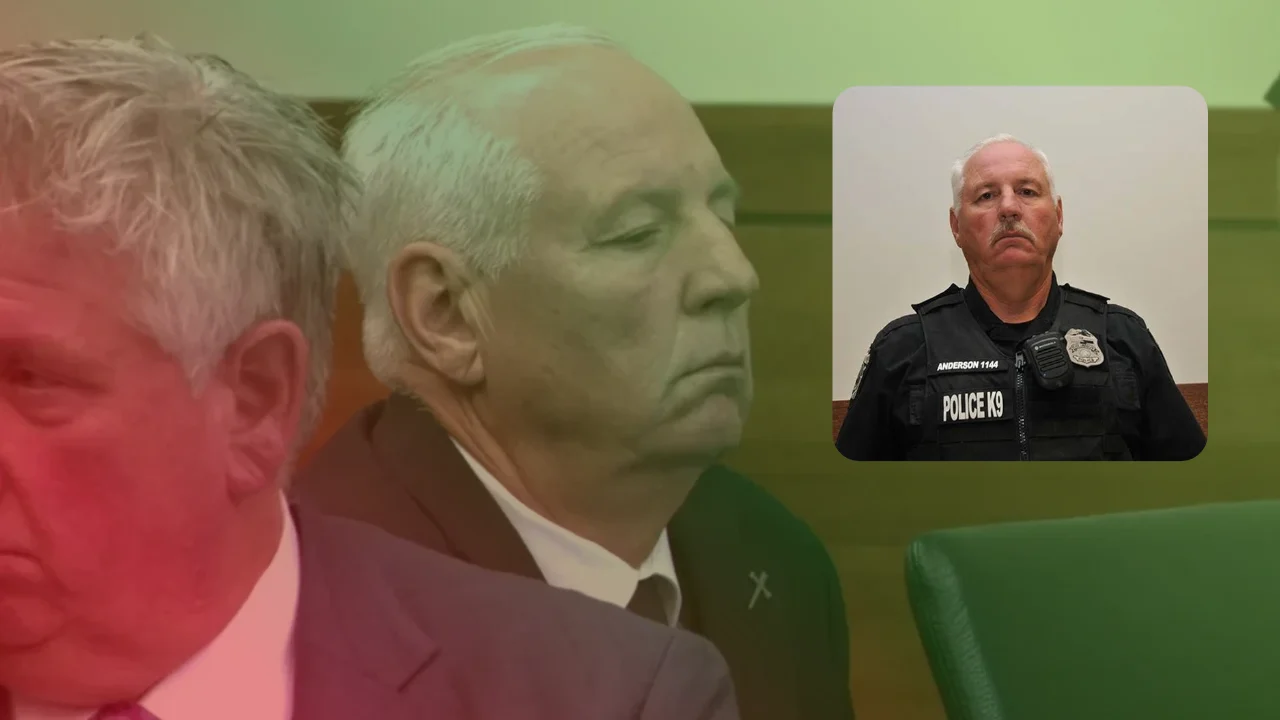
Former Columbus police officer Ricky Anderson was sentenced to three years of probation Wednesday for the 2022 shooting death of 20-year-old Donovan Lewis inside his apartment in the Hilltop neighborhood. A Franklin County judge imposed the sentence after Anderson pleaded guilty to reckless homicide in September, resolving the criminal case without a prison term.
Anderson, 63, was a Columbus police K-9 officer when he shot Lewis during an overnight operation to serve an arrest warrant on Sullivant Avenue on August 30, 2022. Prosecutors agreed to dismiss the original murder charge as part of the plea agreement.
Anderson could face imprisonment if he violates the conditions of his three-year community-control sentence, according to WOSU.
The sentencing ends the criminal prosecution with a reckless-homicide conviction, but separate civil litigation brought by Lewis’ family raises additional questions about the shooting, police accountability and the department’s use of overnight arrest warrants.
Why did Ricky Anderson receive probation instead of prison?
The judge ordered Anderson to serve three years of probation, rather than imposing an immediate prison term.
The sentence followed Anderson’s September 3 guilty plea to reckless homicide, a third-degree felony under Ohio Revised Code Section 2903.041.
The conviction carries potential prison time. However, Ohio law also allows courts to impose community-control sanctions when incarceration is not mandatory.
Under Ohio Revised Code Section 2929.15, community-control sanctions can include probation and other court-ordered restrictions. A court can impose more restrictive sanctions or a prison term if an offender violates the conditions of community control, subject to statutory requirements.
The latest WOSU sentencing report confirms the three-year probation term but does not provide a complete list of the specific conditions imposed on Anderson.
The sentence means Anderson will remain under court supervision rather than immediately enter prison.
What was Anderson’s guilty plea in the Donovan Lewis case?
Anderson entered an Alford plea to reckless homicide on September 3, 2026.
An Alford plea allows a defendant to plead guilty while maintaining that he did not commit the offense as factually alleged.
The defendant acknowledges that prosecutors have enough evidence to establish guilt and that a jury could convict.
In Anderson’s case, the agreement resulted in a reckless-homicide conviction and the dismissal of the original murder charge.
The plea did not require Anderson to admit factual guilt.
Lewis’ mother, Rebecca Duran, said after the September hearing that she accepted the guilty plea but believed it fell short of the punishment her son deserved.
She previously said her family did not want to risk Anderson being acquitted at a murder trial.
What Ohio law applies to Anderson’s sentence?
Several provisions of the Ohio Revised Code are relevant to the case.
Ohio Revised Code 2903.041 — Reckless homicide
This statute prohibits recklessly causing another person’s death.
Reckless homicide is classified as a third-degree felony. This is the offense to which Anderson pleaded guilty.
Ohio Revised Code 2929.14 — Prison terms
Section 2929.14(A)(3)(b) establishes the ordinary prison-term options for a third-degree felony that does not fall under one of the special exceptions.
Those terms range from nine months to 36 months.
Anderson received probation instead of an immediate prison term.
Ohio Revised Code 2929.15 — Community control
This provision governs probation and other community-control sanctions for felony offenses.
It allows a court to impose supervision and provides procedures for handling violations. Depending on the circumstances, a violation can result in stricter sanctions or imprisonment.
Ohio Revised Code 2929.12(G) — Alford pleas and remorse
This provision contains an important rule that is rarely discussed in coverage of Anderson’s case.
When an offender enters an Alford plea, a sentencing judge cannot consider whether the offender demonstrated genuine remorse for the offense.
This restriction concerns one specific sentencing factor. It does not automatically require probation or prohibit a prison sentence.
It is particularly relevant because Anderson maintained that he did not admit factual guilt while accepting the conviction.
What happened inside Donovan Lewis’ Hilltop apartment?
The shooting occurred during an overnight police operation on August 30, 2022.
Four Columbus police officers went to Lewis’ apartment on Sullivant Avenue to serve an outstanding arrest warrant.
The warrant involved allegations that included domestic violence, assault and improper handling of a firearm, according to reporting and court records.
Officers knocked for approximately 10 minutes.
Two other people staying at the apartment eventually came outside and were detained. Lewis remained inside.
Officers requested assistance from Anderson, who arrived with his police K-9 partner, Boef.
The dog entered the apartment and indicated that someone was behind a closed bedroom door.
Anderson and other officers approached the room with their weapons drawn.
When Anderson opened the bedroom door, body-camera footage showed Lewis in bed beginning to sit up. Anderson drew his firearm and fired one shot, striking Lewis in the abdomen.
The Franklin County Prosecutor’s Office said its review of body-camera footage showed that less than two seconds passed between Anderson beginning to open the door and firing.
Anderson said he believed Lewis had a weapon in his hand. A vape pen was subsequently found in Lewis’ bed.
Other officers provided emergency medical care before Lewis was taken by ambulance to OhioHealth Grant Medical Center, where he died.
Why did prosecutors originally charge Anderson with murder?
A Franklin County grand jury indicted Anderson in August 2023 on murder and reckless-homicide charges.
The investigation focused on the circumstances surrounding the shooting, including Anderson’s decision to use deadly force as the bedroom door opened.
Anderson’s defense maintained that he believed Lewis posed a threat and that the shooting was justified under the circumstances.
The case went through multiple delays before the September 2026 plea agreement.
The prosecution ultimately agreed to dismiss the murder charge in exchange for Anderson’s Alford plea to reckless homicide.
The murder charge therefore did not proceed to a jury verdict.
The resulting conviction is for reckless homicide, not murder.
What did the Ohio appeals court decide about the family’s civil lawsuit?
A separate civil case brought by Lewis’ estate remained an important part of the legal history before Anderson’s sentencing.
The case is Estate of Donovan Lewis v. Ricky R. Anderson et al., Franklin County Common Pleas case No. 23CV-1021.
Lewis’ estate, represented by his mother, Rebecca Duran, originally filed the lawsuit on February 16, 2023, against Anderson and four other officers involved in the incident.
The complaint included claims of:
- Wrongful death.
- Civil battery.
- Breach of duty.
- Intentional infliction of emotional distress.
- Negligent infliction of emotional distress.
- Failure to render aid.
- Deprivation of state constitutional and statutory rights.
These were allegations in the civil complaint, not findings that every named officer was legally responsible.
During the civil proceedings, Anderson sought summary judgment, arguing that he was entitled to statutory immunity under Ohio Revised Code Chapter 2744.
The trial court denied his request in August 2024 because factual disputes remained about whether his actions were reckless.
Anderson appealed that decision.
June 4, 2026: Appeals court refuses to grant Anderson immunity
The Ohio 10th District Court of Appeals issued a decision on June 4, 2026, in Estate of Lewis v. Anderson, 2026-Ohio-2096.
The appeals court affirmed the lower court’s denial of Anderson’s summary-judgment motion.
The judges found that reasonable minds could disagree about whether Anderson genuinely perceived an immediate threat of serious harm before firing.
The opinion specifically discussed the body-camera recording, the darkness inside the bedroom and the short amount of time Anderson had to assess the situation.
The court said those circumstances should be evaluated by a fact-finder rather than resolved in Anderson’s favor through summary judgment.
That decision is important, but it does not mean the appeals court found Anderson civilly liable.
It means he could not obtain immunity as a matter of law at that stage of the proceedings.
The civil case is separate from the criminal prosecution, and Anderson’s probation sentence does not itself determine the family’s civil claims.
Did Donovan Lewis’ family also sue the City of Columbus?
Yes.
In April 2024, the family filed a separate federal lawsuit against the City of Columbus and Columbus Division of Police Chief Elaine Bryant, alleging systemic problems with excessive force and policing practices involving Black residents.
The lawsuit sought compensation and departmental reforms.
Among the changes requested were greater transparency about police stops and arrests, independent oversight of officer-involved shootings, public reporting requirements and changes to how police shootings are investigated.
The family also raised concerns about police pensions and the use of public funds for settlements involving officer misconduct.
These were allegations and requested remedies in a civil complaint, not findings that the city or police chief had violated the law.
The federal lawsuit is legally distinct from the criminal case against Anderson and the state wrongful-death lawsuit.
What changed in Columbus police warrant procedures after the shooting?
One of the most significant consequences of Lewis’ death was a change in Columbus Division of Police warrant procedures.
On September 9, 2022, Police Chief Elaine Bryant issued a directive restricting certain overnight arrest-warrant operations at private residences.
Under the department’s Directive 3.01, officers generally cannot serve preplanned arrest warrants at private residences between 11 p.m. and 6 a.m. for misdemeanor offenses, including domestic violence, and nonviolent felony offenses without prior approval from a lieutenant or higher-ranking officer.
The policy also states that a lieutenant should approve an overnight operation only when the danger of allowing the suspect to remain at large outweighs the risks associated with serving the warrant at that time.
Tactical units are exempt from the restriction.
This is a police department directive, not a separate Ohio criminal statute.
The change followed the fatal Sullivant Avenue operation and was intended to provide additional review before certain overnight warrant services.
Duran has also advocated for changes that would make additional oversight requirements more permanent.
Why does the case remain important to Columbus?
The shooting and subsequent legal proceedings have generated continuing debate about the use of deadly force, police accountability and the procedures officers follow when serving arrest warrants.
The case also involved questions about the use of police K-9 units during overnight operations and the limited time available to evaluate a potential threat inside a dark room.
The June 2026 appeals decision showed that the family’s civil claims raised factual questions that could not be resolved simply by granting Anderson statutory immunity.
The criminal case has now reached a conviction and sentencing decision, but its broader implications extend beyond the punishment imposed on one former officer.
The family’s lawsuits and the department’s warrant procedures remain separate issues.
What happens next?
Anderson must comply with the conditions of his three-year probation.
A violation could result in additional court sanctions, potentially including imprisonment under Ohio’s community-control laws.
The family’s civil litigation is not automatically resolved by the criminal sentence.
The sentencing also does not change the legal distinction between the reckless-homicide conviction Anderson accepted and the murder charge prosecutors dismissed under the plea agreement.
The court’s decision gives the criminal prosecution a conclusion, but the separate questions surrounding civil liability and police policy remain part of the case’s wider legal history.
Sources
- WOSU / Ideastream Public Media — Retired Columbus Police Officer Who Shot Donovan Lewis Placed on Three Years Probation, November 4, 2026.
- Franklin County Prosecutor’s Office — Former Officer Ricky Anderson Pleads Guilty in Death of Donavan Lewis, September 3, 2026.
- Ohio 10th District Court of Appeals — Estate of Lewis v. Anderson, 2026-Ohio-2096, June 4, 2026.
- WOSU — Retired Columbus Police Officer Who Shot Donovan Lewis Changes Plea to Reckless Homicide Charge, September 3, 2026.
- WOSU — Donovan Lewis’ Family Sues Columbus Police Officer Who Shot and Killed Him, Four Other Officers, February 16, 2023.
- WOSU — Donovan Lewis’ Family Sues City of Columbus, Police Chief Alleging Systemic Racism, April 18, 2024.
- Columbus Division of Police — Directive 3.01, Arrests and Warrants.
- Ohio Revised Code Sections 2903.041, 2929.12, 2929.14, 2929.15 and 2744.03.
Last updated: November 4, 2026.
Columbus Frontline will update this report if additional sentencing conditions, court filings or developments in the family’s civil litigation become available.