
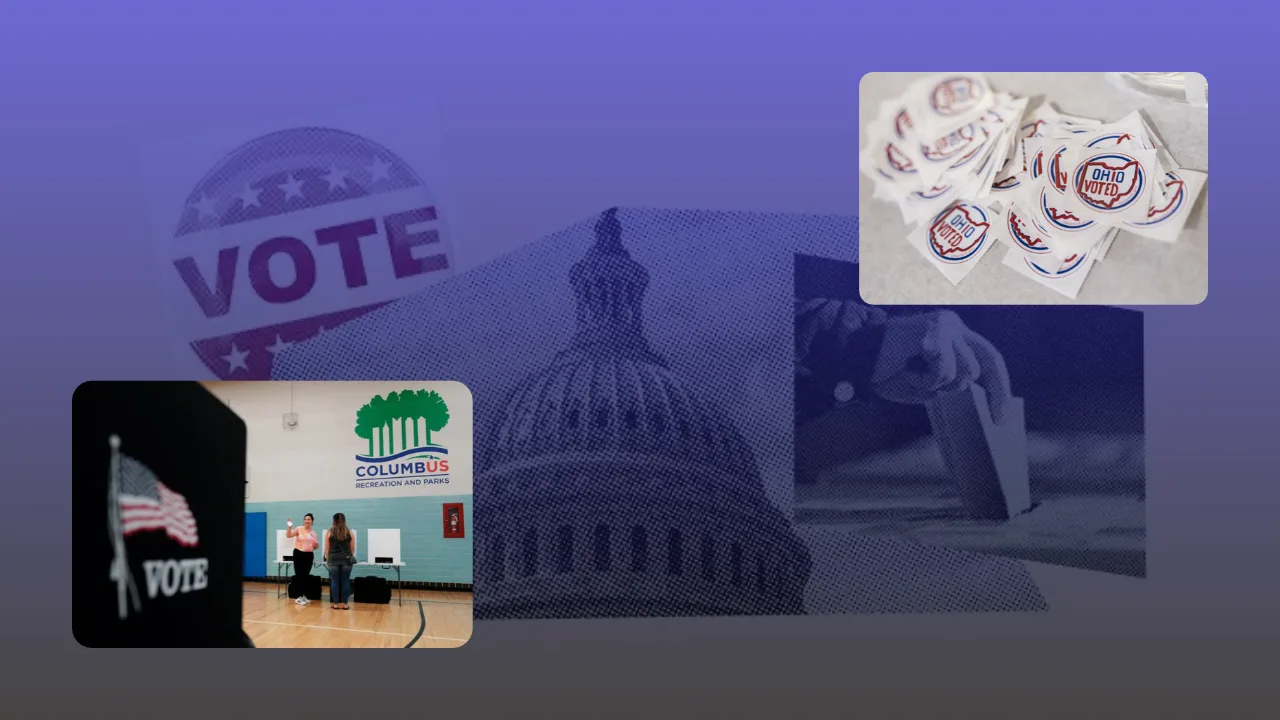
Election Day in Columbus, Ohio is Tuesday, November 3, 2026. Polls are open from 6:30 a.m. to 7:30 p.m. Eastern Time. Ohio requires most in-person voters to show an unexpired photo ID, but a voter who has an ID, registration or address problem can often cast a provisional ballot. Anyone already in line at 7:30 p.m. has the right to stay and vote.
Ohio’s voter-registration deadline was October 5, 2026, so a first-time voter cannot register at a Columbus polling place on November 3. Regular absentee-ballot applications closed on October 27, 2026, and early in-person voting ended on November 1. What remains is Election Day voting, and the rules below decide whether your ballot is counted.
This guide covers the Ohio Revised Code and federal laws that protect Columbus voters, the Franklin County Board of Elections procedures, the State Issue 3 photo-ID amendment, the City of Columbus charter issues, and what to do if a poll worker, observer or anyone else interferes with your vote.
Geography matters. Columbus extends beyond Franklin County into parts of Delaware and Fairfield counties. Your registered residential address, not a “Columbus” mailing address, decides your county Board of Elections, your precinct and your polling place.
Quick Facts: Columbus, Ohio Election Day, November 3, 2026
| Detail | Rule for November 3, 2026 |
| Election Day | Tuesday, November 3, 2026 |
| Polls open | 6:30 a.m. Eastern |
| Polls close | 7:30 p.m. Eastern |
| Voters in line at closing | May stay and vote |
| Voter-registration deadline | October 5, 2026 (passed) |
| Same-day registration | Not available |
| Residency requirement | Ohio resident at least 30 days before Election Day |
| Minimum age | 18 on or before November 3, 2026 |
| In-person voter ID | Unexpired government photo ID required (see list below) |
| No accepted ID | Provisional ballot; bring ID to the county Board of Elections within four days after the election (by November 7, 2026) |
| Regular absentee application deadline | October 27, 2026, 8:30 p.m. (passed) |
| Regular absentee ballot return deadline | Must be received by the county Board of Elections by 7:30 p.m. on November 3 (postmark alone is not enough) |
| Military and overseas (UOCAVA) ballots by mail | Must be received by November 7, 2026 |
| Franklin County Board of Elections | 1700 Morse Road, Columbus, OH 43229 |
| Franklin County telephone | 614-525-3100 |
| Ohio Secretary of State voter hotline | 1-877-767-6446 |
| Election Protection hotline | 866-OUR-VOTE (866-687-8683) |
| Official Franklin County website | Franklin County Board of Elections |
| Polling-place lookup | Franklin County polling location search |
| Registration and sample-ballot lookup | Franklin County voter information search |
| Federal complaints | U.S. Department of Justice Civil Rights Division |
The Ohio Secretary of State’s official 2026 voting schedule sets the registration deadline, poll hours and absentee deadlines. The Franklin County Board of Elections homepage confirms the 6:30 a.m. to 7:30 p.m. hours for November 3.
1. Where Columbus, Ohio Voters Must Vote on November 3
Ohio assigns every voter to a precinct, and each precinct has one polling location. You generally must vote in the precinct where you live. You cannot walk into any school, library or recreation center in Columbus and vote there.
How Franklin County Voters Find Their Polling Place
Use the Franklin County polling location search and enter your full residential address. You can also use the Franklin County voter information search to confirm your registration and see your sample ballot, or call 614-525-3100.
Franklin County can change polling places between elections, and the Board mails notices to affected voters. For the May 2026 primary the Board listed 298 voting locations. Do not rely on where you voted last time. Check again before you leave home.
Columbus Addresses in Delaware and Fairfield Counties
If your Columbus address is outside Franklin County, your election office is the Delaware County or Fairfield County Board of Elections. The Franklin County lookup will not give you reliable information for those addresses.
Is the Franklin County Board of Elections at 1700 Morse Road a Regular Polling Place?
No. The Board of Elections office at 1700 Morse Road, Columbus, OH 43229 handles registration records, absentee ballots, early voting and provisional-ballot corrections. Your Election Day polling place is the one assigned to your precinct. The Morse Road office does have special roles under Ohio law, including the provisional-ballot ID correction period and certain address-change procedures under Ohio Revised Code §3503.16.
2. Who Is Eligible to Vote in Columbus, Ohio? (Ohio Revised Code §3503.01)
To vote on November 3, 2026, you must:
- Be a United States citizen.
- Be at least 18 years old on or before November 3, 2026.
- Have lived in Ohio for at least 30 days immediately before the election.
- Be registered at your current address by the October 5, 2026 deadline (subject to the address-change and name-change procedures in Section 4).
- Not be currently incarcerated for a felony conviction.
- Not have been declared incompetent for voting purposes by a probate court.
Can Green Card Holders Vote in Columbus, Ohio?
No. Permanent residents are not U.S. citizens and cannot vote in federal, Ohio or Columbus elections. Federal law also makes it a crime for a noncitizen to vote in a federal election.
Can College Students Vote in Columbus Using Their Campus Address?
Yes, if the student treats the Columbus address as their voting residence under Ohio law. A student cannot be registered and vote at two addresses. A student who moved to Columbus from elsewhere in Ohio and did not update their registration before October 5 should read the address-change rules in Section 4 and call the Board of Elections before Election Day.
Can Homeless Voters Vote in Columbus, Ohio?
Yes. A fixed address, lease or utility bill is not required. A voter without a traditional home can generally use a shelter or another place where they regularly stay as a voting residence. Contact the Franklin County Board of Elections at 614-525-3100 to confirm the correct address for your registration.
Can People With Felony Convictions Vote in Ohio? (Ohio Revised Code §2961.01)
Ohio does not permanently remove voting rights for most felony convictions. The deciding factor is whether the person is currently incarcerated for a felony.
| Status | Can the person vote in Ohio? |
| Currently incarcerated for a felony | No |
| Released from prison, on parole | Yes, if registered |
| On probation or community control | Yes, if registered |
| Completed the felony sentence | Yes, if registered |
| Convicted of a misdemeanor | Yes, if registered |
| Convicted of violating election laws (see statute) | May be barred |
If your registration was canceled because of incarceration, you must register again. The October 5 deadline has passed, so a provisional ballot is not a substitute for a timely new registration.
Can a Person Under Guardianship Vote in Ohio?
A guardianship does not by itself remove the right to vote. Ohio’s disqualification applies to a person a probate court has specifically declared incompetent for voting purposes. A disability, mental-health treatment or a guardian is not enough on its own.
3. Ohio Voter Registration Deadline: Can Columbus Residents Register on Election Day?
No. The deadline for the November 3, 2026 election was October 5, 2026. Ohio has no same-day registration for this general election, and a provisional ballot does not create a new registration opportunity.
The next steps depend on your situation:
- Never registered, or registration canceled: You cannot vote in this election. Register early for the next one.
- Registered in Ohio but moved or changed your name: Section 4 explains the specific procedures that may still let you vote.
- Moved to Ohio from another state less than 30 days before the election: The 30-day Ohio residency requirement may not be met. Contact the election office in your former state about your options there.
4. Moved or Changed Your Name Before November 3? Ohio Revised Code §3503.16 Explains What You Can Do
Ohio Revised Code §3503.16 lets some already-registered voters vote even though they missed the deadline to update their record. The correct procedure depends on the type of change.
| Situation | General procedure |
| Moved within the same precinct | Go to your assigned polling place, complete and sign the change-of-residence notice, show accepted photo ID and vote a regular ballot |
| Moved to a different precinct in the same county | Vote at the correct new precinct (or as the Board directs) using a provisional ballot with a written affirmation of your new address |
| Moved from another Ohio county to Franklin County | A specialized provisional-ballot procedure may apply, often through the Board of Elections office; call 614-525-3100 before traveling |
| Legal name change (Form 10-L) | Complete the Notice of Name Change and provide proof such as a marriage license or court order; if you cannot provide proof, a provisional ballot may be required |
Do not vote at your old polling place just because it is familiar. A provisional ballot cast in the wrong precinct generally cannot be counted.
5. Ohio Photo ID Law for Columbus Voters: What Counts and What Does Not
Ohio has required photo ID for in-person voting since House Bill 458 took effect in 2023. The ID must show your name and photograph and must be unexpired. You must also state your full name and current address to the poll worker.
Accepted Photo IDs at Columbus Polling Places
- Ohio driver’s license (unexpired)
- State of Ohio identification card (unexpired)
- Interim ID form issued by the Ohio Bureau of Motor Vehicles
- U.S. passport or passport card
- U.S. military ID
- U.S. military dependent ID
- Ohio National Guard ID
- U.S. Department of Veterans Affairs ID
A free Ohio photo ID is available from the BMV for voting purposes.
IDs and Documents Not Accepted as Ohio Voter ID
- Out-of-state driver’s licenses or ID cards
- Student IDs
- Ohio Mobile ID (digital)
- Utility bills, bank statements, paychecks and government checks
- Social Security cards and birth certificates
- Insurance cards
- Voter-registration acknowledgment notices
See the Ohio Secretary of State voter ID requirements for the current official list.
Does the Address on Your Ohio Photo ID Have to Match?
Ohio’s photo-ID rule looks at your name, your photograph and the expiration date. Your registration record, not the address printed on your ID, decides your precinct. If you moved, tell the poll worker your current address and follow Section 4.
What If Your Ohio ID Says “NONCITIZEN”? (Senate Bill 293, Ohio Revised Code §3505.20)
Under Senate Bill 293, effective March 20, 2026, election officials must challenge a voter whose Ohio BMV-issued ID carries a noncitizen notation. The voter can still vote if they provide qualifying proof of citizenship and take the required oath. Accepted proof includes a current Ohio license or state ID without the notation, a U.S. birth certificate, a current U.S. passport or passport card, a certificate of naturalization or citizenship, a consular report of birth abroad, or an I-797 notice replacing a naturalization document. A voter who cannot provide proof at the polling place may cast a provisional ballot. This rule does not require every Ohio voter to show a birth certificate or passport.
See Ohio Revised Code §3505.18 and §3505.20.
6. Ohio State Issue 3 on the November 3, 2026 Ballot: Photo ID Constitutional Amendment
State Issue 3 is the only statewide ballot issue in Ohio in 2026. It was placed on the ballot by the General Assembly through Substitute Senate Joint Resolution 10, and the Ohio Ballot Board approved its language in August 2026.
- What it does: It would add a new Section 5 to Article V of the Ohio Constitution requiring voters to present photo identification to vote, writing into the constitution the photo-ID requirement Ohio has had by statute since 2023.
- What it does not do immediately: Photo ID is already required for in-person voting. News reports on the amendment say it would not immediately change the rules for mail-in voting, but its language allows the legislature to address that later.
- Effective date and vote needed: A simple majority is required, and the amendment would take effect immediately if approved.
- Arguments: Supporters say a constitutional rule gives stability and protects election integrity. Opponents, including Democratic legislators who voted against putting it on the ballot, say it is unnecessary because photo ID is already law.
This article takes no position on Issue 3. Read the official ballot language and the arguments for and against in the Ohio Secretary of State’s Issue 3 materials.
Columbus City Issues 8 and 9: City Council Charter Amendments
Eligible City of Columbus voters may also see City Issues 8 and 9 on their ballots. Both concern how members of Columbus City Council are elected, including district voting and at-large seats. They apply only to voters who live inside the City of Columbus. A Columbus mailing address does not guarantee they will appear on your ballot. Review your exact sample ballot through the Franklin County voter information search or the Ohio ballot marking tool.
7. Provisional Ballots in Ohio: When Columbus Voters Can Request One (Ohio Revised Code §3505.181)
A provisional ballot is kept separate until the Board of Elections verifies the voter’s eligibility. It is not automatically counted. Under Ohio Revised Code §3505.181, a provisional ballot is used when:
- Your name is not in the pollbook for the precinct.
- Election officials cannot confirm your eligibility.
- You do not have an accepted photo ID.
- The pollbook shows you requested an absentee ballot.
- Mail sent to your registered address was returned as undeliverable.
- Your registration or eligibility has been challenged.
- Your signature does not appear to match your registration record.
- Officials suspect possible voter impersonation.
- You moved to a different precinct without updating your registration by the deadline.
- You changed your name without completing the required update or proof.
What to Do If Your Name Is Not in the Pollbook
- Ask the poll worker to search again, including alternate spellings.
- Confirm your registered address and check that you are at the correct precinct.
- Call the Franklin County Board of Elections at 614-525-3100 if you are unsure.
- Ask for a provisional ballot if you believe you are registered and in the right precinct.
- Complete the required affirmation and keep your provisional-ballot receipt or tracking information.
Can You Vote Provisionally at Any Columbus Polling Place?
No. Under the Ohio Secretary of State’s Election Official Manual, Chapter 8, a provisional ballot cast in the wrong precinct generally is not counted, except in limited situations where an election official failed to direct the voter to the correct precinct at a multi-precinct location. Ask for directions to your correct precinct first.
Missing Photo ID: The Four-Day Cure Period (by November 7, 2026)
If you vote provisionally because you lack accepted photo ID, you must take an accepted ID to your county Board of Elections within four days after Election Day. For Franklin County voters that means 1700 Morse Road, Columbus, OH 43229, between November 4 and November 7, 2026. The Board must be open during this period. Confirm the hours at 614-525-3100. Telling the office your license number by phone is not a substitute for following the official procedure.
Religious Objection to Being Photographed (Form 12-O)
A voter with a sincere religious objection to being photographed may complete the Affidavit of Religious Objection (Form 12-O) when casting the provisional ballot or at the Board of Elections within the same four-day period.
How to Check Whether Your Provisional Ballot Counted (Ohio Revised Code §3505.183)
Ohio Revised Code §3505.183 governs how provisional ballots are reviewed and counted. Ohio provides a way for provisional voters to learn whether their ballot was counted and, if not, why. Keep your provisional receipt and ask the Franklin County Board of Elections how to check your status.
8. Requested an Absentee Ballot but Want to Vote in Person in Columbus?
If the pollbook shows you requested an absentee ballot, you generally must vote a provisional ballot at your polling place, even if the ballot never arrived or you did not return it. The Board will confirm that no absentee ballot from you was received and counted before it counts the provisional ballot.
Deadlines and Where to Return an Absentee Ballot
- A regular absentee ballot must reach the Franklin County Board of Elections by 7:30 p.m. on November 3, 2026. A November 3 postmark does not count.
- Return it by mail early enough to arrive, or use the secure drop box at the Board of Elections, 1700 Morse Road, Columbus, OH 43229. See Franklin County Absentee and Early Voting.
- Do not take a completed absentee ballot to an ordinary polling place. Poll workers are not supposed to accept it there.
- Sign the identification envelope and complete the identification information the form requires. An unsigned or incomplete envelope can keep the ballot from being counted.
Who May Deliver an Absentee Ballot for Another Person? (Ohio Revised Code §3509.05)
Ohio Revised Code §3509.05 lets a qualifying near relative deliver a voter’s completed ballot, including a spouse, parent, grandparent, brother or sister, child, stepparent or stepchild, aunt or uncle, niece or nephew, and in-laws as listed in the statute. Do not give your ballot to an unauthorized campaign worker, stranger or collection service.
Military and Overseas Voters (UOCAVA)
Qualifying military and overseas absentee ballots returned by mail must be received by November 7, 2026, under the state calendar. These voters should follow the instructions of the Federal Voting Assistance Program and their county Board of Elections under the Uniformed and Overseas Citizens Absentee Voting Act.
Hospitalized on Election Day: Emergency Absentee Ballot (Form 11-B)
A voter hospitalized because of an accident or unforeseen medical emergency after the regular absentee deadline may qualify for an emergency absentee ballot by submitting Form 11-B by 3 p.m. on November 3. This is a narrow exception, not a second application period.
9. Disability Voting Rights in Columbus, Ohio: Accessible Machines, Curbside Voting and Assistance
The Americans with Disabilities Act and the Help America Vote Act require accessible voting for people with disabilities. Ohio polling places must be accessible, and voting systems must offer options for private and independent voting.
- Accessible equipment: Depending on the system, this can include audio ballots, large print, screen magnification, high-contrast displays and other assistive features. If equipment is not working, tell the lead poll worker and ask for an accessible alternative.
- Curbside voting: A voter who cannot enter the polling place because of a disability can have election officials bring a ballot outside. Two officials from different political parties normally do this. Have someone go inside and notify the poll workers.
- Help marking the ballot (Ohio Revised Code §3505.24 and 52 U.S.C. §10508): A voter who needs help because of blindness, disability or inability to read or write may choose a person to assist. The helper cannot be the voter’s employer, an agent of the employer, or an officer or agent of the voter’s union. If the voter chooses no one, two election officials from different parties may help. The helper must not influence the voter’s choices or reveal how the voter voted.
- Time in the booth: Ohio’s ten-minute limit when all booths are in use and others are waiting does not apply to a person who needs an accessible voting machine under Ohio Revised Code §3505.23.
10. Language Assistance and Help Reading a Ballot in Columbus
Federal law, 52 U.S.C. §10508, protects the right of a voter who needs help reading or marking a ballot to receive assistance from a person of their choice, subject to the exceptions above. Availability of translated materials and interpreters depends on Voting Rights Act coverage and local arrangements. Voters who want interpreter or translated-material information should contact the Franklin County Board of Elections at 614-525-3100 as early as possible.
11. Voter Intimidation Laws: What Is Illegal Near Columbus Polling Places?
Federal law prohibits intimidation, threats and coercion aimed at voters. Section 11(b) of the Voting Rights Act, 52 U.S.C. §10307(b), covers private individuals as well as government officials. Related federal provisions include 52 U.S.C. §10101(b) and 18 U.S.C. §594.
Ohio law separately protects the election process. Ohio Revised Code §3599.24 prohibits interfering with election administration, including intimidating election officials, destroying election property and loitering to hinder or delay the election. Ohio Revised Code §3599.20 prohibits interfering with a voter marking a ballot and attempting to induce a voter to show how they voted.
Examples that may be unlawful depending on the facts include threatening someone over how they vote, physically blocking voters, threatening arrest without a lawful basis, harassing voters because of race or language, and pressuring someone to vote a particular way. A heated disagreement is not automatically a crime. The conduct, intent and context matter.
What to Do If Someone Threatens or Intimidates You at a Columbus Polling Place
- If there is violence or an immediate threat, move to safety and call 911.
- Tell the lead poll worker or voting-location manager.
- Note the time, place and what happened, and get witness details if you can do so safely.
- Call the Franklin County Board of Elections at 614-525-3100.
- Call the Election Protection hotline at 866-OUR-VOTE (866-687-8683).
- Report possible federal violations to the U.S. Department of Justice Civil Rights Division.
12. Ohio Electioneering Rules: The 100-Foot Boundary and Campaigning Near Polling Places
- The 100-foot flags (Ohio Revised Code §3501.30): Election officials mark the restricted area with small American flags about 100 feet from the polling place entrance, as close to that distance as physically possible.
- No campaigning in the restricted area (Ohio Revised Code §3501.35): Campaigning, distributing campaign material and loitering are prohibited between the polling place and the flags. If the line of voters extends past the flags, the restriction also applies within ten feet of voters in that line. No one may hinder or delay a voter reaching or leaving the polling place.
- Campaign clothing and materials: Do not bring campaign signs or materials into the restricted area. Ask a poll worker whether campaign-branded clothing or buttons are allowed at your location, because the application of the rule to clothing can be a point of dispute.
- Election observers and challengers (Ohio Revised Code §3505.21): Properly appointed observers may watch the process, but they are not poll workers and cannot decide whether you may vote. Observers may not handle ballots or equipment, interfere with poll workers, campaign, or block, harass or intimidate voters. Election officials can remove an observer who breaks the rules. If you are challenged, speak to an election official, not the observer.
13. Can Your Ohio Employer Stop You From Voting? (Ohio Revised Code §3599.06)
Ohio Revised Code §3599.06 prohibits an employer from discharging or threatening to discharge an employee for taking a reasonable amount of time to vote, and from using force, restraint or threats to influence or prevent an employee’s vote. The statute does not guarantee a specific number of paid hours off. With polls open for 13 hours, most workers can vote before or after a shift, but if your schedule makes that impossible, ask your employer in advance and keep a record of the request.
14. Phones, Photos and Ballot Selfies in Ohio Polling Places
Ohio’s ballot-secrecy rules are in Ohio Revised Code §3599.20, which makes it a fifth-degree felony to allow your ballot to be seen by another with the apparent intention of letting it be known how you are about to vote. State law does not define “selfie” or “photo,” and the statute does not expressly address cameras, which is why election officials generally warn against photographing a marked ballot. Avoid photographing your ballot, other voters or other voters’ ballots, and follow poll-worker instructions. Ohio’s observer rules separately restrict recording inside polling locations.
15. How Long Can You Take in the Voting Booth? (Ohio Revised Code §3505.23)
Ohio Revised Code §3505.23 sets a ten-minute limit on occupying a voting compartment or machine when all compartments or machines are in use and voters are waiting. The limit does not apply to a person who needs an accessible voting machine. Election officials are encouraged to apply it with flexibility and offer help to a voter who needs more time.
16. Machine Problems, Scanner Rejections and Ballot Mistakes in Columbus
A broken machine does not end your right to vote. Tell a poll worker immediately and ask:
- Was my ballot recorded?
- Should I feed it in again?
- Is another machine or a paper ballot available?
- Do I need a replacement ballot?
If you make a mistake, tell an election official before you cast the ballot and ask for a replacement under Ohio Revised Code §3505.23. Once a ballot is cast it generally cannot be replaced. If the problem is not fixed, ask for the voting-location manager and call 614-525-3100.
17. What If a Poll Worker in Columbus Refuses to Let You Vote?
Stay calm and ask for the legal procedure.
- “Can you check my registration again?”
- “Am I at the correct precinct?”
- “What specific requirement have I not met?”
- “Can I show another accepted ID?”
- “May I cast a provisional ballot, and what must I do afterward for it to count?”
If you are still turned away, ask for the voting-location manager, call the Franklin County Board of Elections at 614-525-3100, and call 866-OUR-VOTE. A poll worker’s mistake does not cancel your rights, but a provisional ballot is counted only if the Board verifies your eligibility, so follow every post-election instruction, including the November 7 ID deadline where it applies.
18. Federal and Ohio Voting Laws That Protect Columbus Voters
| Law | What it covers |
| Ohio Revised Code §3503.01 | Voter qualifications and residence |
| Ohio Revised Code §3503.16 | Change of address or name before an election |
| Ohio Revised Code §3505.18 | Identification and procedure when a voter enters the polling place |
| Ohio Revised Code §3505.20 | Challenges to a voter at the polling place |
| Ohio Revised Code §3505.21 | Challengers and observers |
| Ohio Revised Code §3505.181 | Provisional-ballot eligibility |
| Ohio Revised Code §3505.183 | Provisional-ballot review and counting |
| Ohio Revised Code §3505.23 | Ten-minute booth limit and ballot errors |
| Ohio Revised Code §3505.24 | Assistance for voters who need help |
| Ohio Revised Code §3501.30 | Polling-place supplies and the 100-foot flag boundary |
| Ohio Revised Code §3501.35 | Campaigning and loitering near polling places |
| Ohio Revised Code §3509.05 | Absentee-ballot delivery and return |
| Ohio Revised Code §3599.06 | Employer interference with voting |
| Ohio Revised Code §3599.20 | Ballot secrecy and interference with marking a ballot |
| Ohio Revised Code §3599.24 | Interference with the conduct of an election |
| Ohio Revised Code §2961.01 | Voting rights and felony convictions |
| Ohio House Bill 458 (2023) | Photo-ID requirement and absentee-return changes |
| Ohio Senate Bill 293 (2026) | Noncitizen-notation ID challenge procedure |
| 52 U.S.C. §10307(b) (Voting Rights Act §11(b)) | Prohibition on voter intimidation, threats and coercion |
| 52 U.S.C. §10508 | Assistance for blind, disabled and illiterate voters |
| Help America Vote Act | Provisional voting, accessible systems and election administration |
| Americans with Disabilities Act | Equal access to voting programs and polling places |
| National Voter Registration Act | Registration procedures and list maintenance |
| Uniformed and Overseas Citizens Absentee Voting Act | Military and overseas absentee voting |
19. Columbus, Ohio Election Day Checklist for November 3, 2026
| Task | What to confirm |
| Registration | Active and at your current address |
| County | Franklin, Delaware or Fairfield |
| Polling place | Verified through the official lookup |
| Ballot | Sample ballot reviewed, including State Issue 3 and any City of Columbus issues |
| Photo ID | Unexpired and on the accepted list |
| Absentee ballot | If issued, received by the Board by 7:30 p.m., or vote provisionally |
| Accessibility | Know your curbside and machine options |
| Time | Allow for lines; remember the 7:30 p.m. line rule |
| Phone numbers saved | 614-525-3100 (Franklin BOE), 1-877-767-6446 (Ohio SOS), 866-OUR-VOTE |
What Not to Do at a Columbus Polling Place
- Do not vote more than once or use another person’s identity.
- Do not give a false residential address.
- Do not assume any precinct will count your ballot.
- Do not give a completed absentee ballot to an unauthorized person.
- Do not photograph your marked ballot or other voters’ ballots.
- Do not campaign inside the 100-foot boundary.
- Do not leave without asking whether a provisional ballot is available.
20. Key Dates for the November 3, 2026 Election in Columbus, Ohio
| Date | Event |
| October 5, 2026 | Voter-registration deadline |
| October 6, 2026 | Early voting and absentee voting begin |
| October 27, 2026, 8:30 p.m. | Regular absentee application deadline |
| November 1, 2026 | Last day of early in-person voting |
| November 3, 2026, 6:30 a.m. | Polls open |
| November 3, 2026, 7:30 p.m. | Polls close; regular absentee ballots must be received |
| November 4–7, 2026 | Four-day provisional-ballot correction period |
| November 7, 2026 | Deadline to provide missing photo ID; military and overseas mail ballots must be received |
22. Official Sources: Franklin County, Ohio and Federal Voting Resources
Franklin County Board of Elections (1700 Morse Road, Columbus, OH 43229; 614-525-3100)
- Official website
- Polling location search
- Voter information and sample ballot
- Absentee and early voting
Ohio Secretary of State (1-877-767-6446)
- 2026 voting schedule
- Voter ID requirements
- Voting FAQs
- State Issue 3 materials
- Election Official Manual, Chapter 8 (Provisional Voting)
- Ohio ballot marking tool
Federal and nonprofit resources
- U.S. Department of Justice Civil Rights Division complaint portal
- U.S. Election Assistance Commission
- Federal Voting Assistance Program
- Election Protection hotline: 866-OUR-VOTE (866-687-8683)
Statutes: R.C. §3503.16, §3505.181, §3505.183, §3505.23, §3599.06, §3599.20, §3599.24, 52 U.S.C. §10307, 52 U.S.C. §10508
Disclaimer: This article is general legal information, not legal advice. Ohio election rules can depend on your address, precinct and registration record. Confirm your polling place, ballot and eligibility with your county Board of Elections. AllAboutLawyer.com is an independent legal information website, not a law firm.